 Your Wish, Hand-Painted.
IWISHART ART GUIDE
How to Choose the Right Size Large Wall Art for a Living Room
Measure your sofa, wall and sightlines to choose large living-room art with balanced proportions, practical hanging height and room-aware framing.
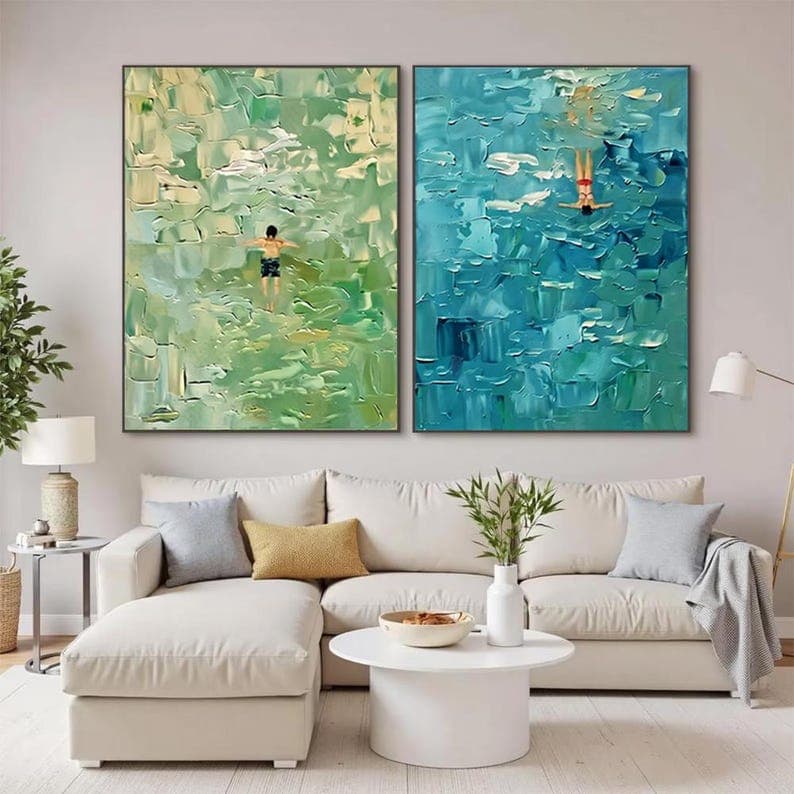
Start with the furniture, not the empty wall
A large blank wall can make almost any artwork look too small while you are shopping online. The more reliable reference is the furniture and architecture that will visually support the piece. Above a sofa, console or sideboard, the artwork should read as part of one composition rather than as an isolated rectangle floating near the ceiling.
A useful starting range is roughly two-thirds to three-quarters of the width of the furniture below. This is a design guideline, not a purchasing formula. A 90-inch sofa, for example, often works with art approximately 60 to 68 inches wide. You may move outside that range if a floor lamp reduces the usable wall, a sectional extends past the main seating zone, or the painting has an unusually quiet or dense composition.
Always compare finished outside dimensions. A 60-inch canvas placed in a wide floating frame occupies more wall than an unframed 60-inch canvas. For a diptych or triptych, include every gap between panels in the total width. These details are small on a product page but decisive in the room.
Measure the wall as a composition
Record the wall width and ceiling height, then measure the sofa, console, fireplace or architectural opening closest to the proposed artwork. Note obstructions such as switches, thermostats, sconces, curtains and doors. The objective is not to fill every available inch; it is to define the zone in which the artwork can sit without competing with practical features.
Mark the proposed finished size on the wall with low-tack painter's tape. Step back to the room entrance, the main seat and any adjacent dining or kitchen area. A size that seems generous from five feet away may feel restrained across an open-plan room. Photographing the taped outline also makes side-by-side size comparisons easier.
If you are choosing between two sizes, evaluate negative space. Deliberate breathing room around a painting feels calm. Excessive empty space that leaves the work disconnected from the sofa feels accidental. In a narrow room, preserving side clearance can matter more than maximizing width.
A practical measuring checklist
Write down wall width, furniture width, desired artwork width, canvas height, frame allowance, panel gaps, ceiling clearance and the distance from the top of the furniture. Ask the seller whether listed dimensions refer to the painted canvas or the complete framed piece.
Single canvas, pair or triptych?
One large canvas creates a quiet focal point and is easier to align. A pair introduces symmetry. A triptych can span a long sofa or sectional, but the composition and gaps must be planned together. Treat grouped panels as one artwork when calculating total width and center point.
Living room artwork size chart
Use these ranges as a first visual test, then adjust for the frame, lamps, wall boundaries and composition.
| Sofa width | Starting artwork width | Best format to test | Check before ordering |
|---|---|---|---|
| 60 in / 152 cm | 40–45 in / 102–114 cm | Single horizontal or square | Side-table clearance |
| 72 in / 183 cm | 48–54 in / 122–137 cm | Horizontal canvas or pair | Frame outside width |
| 84 in / 213 cm | 56–63 in / 142–160 cm | Large horizontal canvas | Lamps and wall edges |
| 90 in / 229 cm | 60–68 in / 152–173 cm | Single work or triptych | Include panel gaps |
| 96 in / 244 cm | 64–72 in / 163–183 cm | Oversized canvas or set | Delivery access and weight |
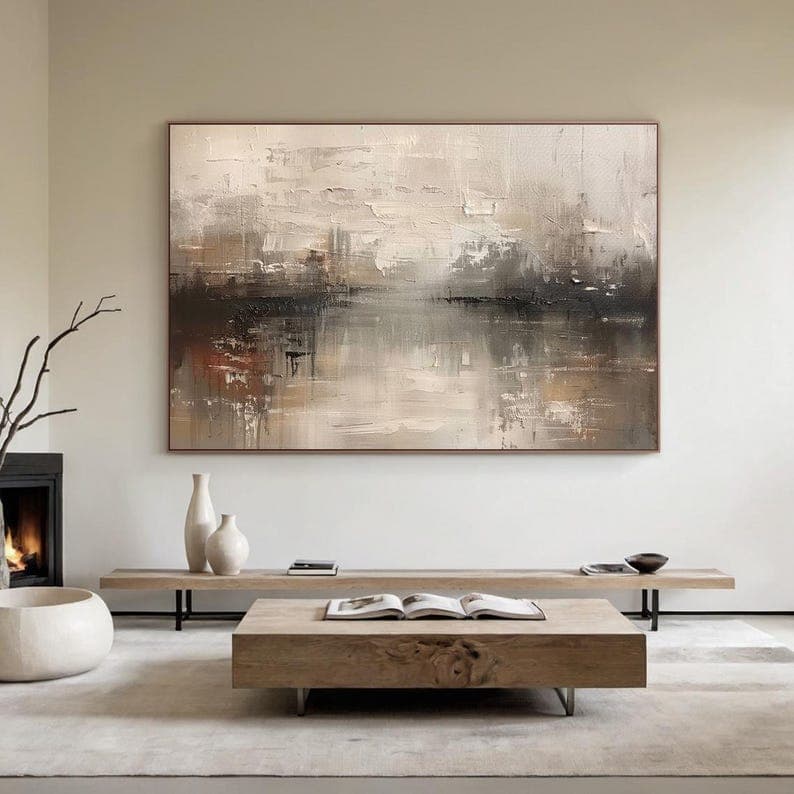
Choose orientation from the room's geometry
Horizontal art generally follows a long sofa, dining sideboard or low media unit. Vertical art is useful beside a doorway, over a narrow console or in a room with high ceilings. Square work can provide a centered pause above compact furniture, while panoramic art suits long uninterrupted walls.
Do not choose orientation from the product image alone. Notice the room's dominant lines. A low sectional, long rug and horizontal windows may support a landscape-format painting. A tall fireplace or double-height wall may need vertical emphasis. The artwork can echo those lines or deliberately counter them, but the decision should be visible and intentional.
For custom-sized artwork, preserve the character of the original composition. Stretching a square design into an extreme panorama can make forms feel empty or distorted. Ask how the composition will be adapted, whether important elements will move, and whether an approval image will show proportions before shipment.
Set a hanging height that works with seating
Generic center-height rules are helpful in galleries, but living rooms contain sofas, tables and seated sightlines. Begin by positioning the lower edge of the artwork about 6 to 10 inches above the sofa back, then assess the complete arrangement. A tall frame, low ceiling or deep sofa may require adjustment.
Art hung too high loses its relationship with the furniture. Art hung too low can feel cramped or risk contact with heads and cushions. If people regularly sit against a high-backed sofa, check physical clearance as well as appearance. Over a console, leave enough room for objects without allowing lamps or branches to cover the main area of the painting.
The visual center should feel natural from normal standing and seated positions. Before drilling, tape the outline and place a temporary center mark. Check it in daylight and after the room's evening lights are on.
Account for color, texture and visual weight
Two paintings with identical measurements can occupy a room differently. High contrast, saturated color and heavy texture tend to feel visually stronger. Pale neutral work with broad open areas may need a larger scale to achieve the same presence. This is why dimensions should be reviewed alongside an accurate room mockup or taped wall outline.
Large textured wall art changes as light moves across raised paint. Side lighting can emphasize palette-knife ridges and layered surfaces; flat frontal light makes relief quieter. Review sample images under more than one lighting condition when possible. Avoid relying on a heavily edited room rendering as proof of exact color or scale.
A frame adds both size and definition. A slim floating frame gives a canvas a clean boundary while keeping a small shadow gap around it. Dark frames increase contrast; pale wood and warm metal can connect the work to floors, tables or hardware. Select the frame after considering the room, not as an isolated product option.
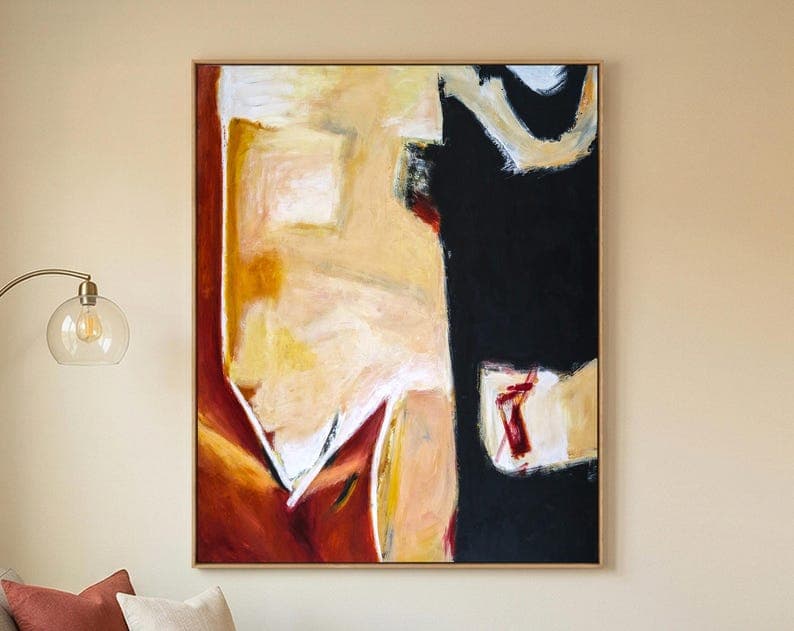
Plan delivery and installation before ordering
Large art must reach the wall before it can improve the room. Measure doors, elevators, stair turns and narrow corridors for stretched or framed artwork. If access is restricted, a rolled canvas may be easier to ship, but it will need professional stretching and possibly framing after arrival. Confirm whether extra canvas is provided for stretching.
Ask for the finished weight and recommended hanging approach, but treat the wall construction as a site condition. Drywall, masonry, tile and timber require different fixings. Heavy or multi-panel work should be installed by someone who can identify the substrate, select rated hardware and align the piece safely.
Before installation, inspect the surface, corners, frame and hanging hardware. Keep packaging until the work has been checked. For custom or made-to-order pieces, confirm size, orientation, palette, frame, shipping format and the approval process in writing before production begins.
Common size and placement mistakes
The most frequent mistake is buying for the wall instead of the furniture grouping. Other problems include overlooking frame width, ignoring triptych gaps, hanging art too high, selecting a shape that fights the architecture, and forgetting access constraints. Each can be caught with measurements and a taped outline.
Another mistake is expecting an online room mockup to be perfectly scaled. Mockups are useful for direction, but lens distortion, unknown furniture dimensions and screen color can mislead. Use them with real measurements, not in place of them.
Finally, do not assume bigger is always better. A large painting needs enough surrounding space to be read comfortably. The right size creates connection and balance; it does not simply occupy the maximum possible area.
A clear decision process
Measure the wall and anchor furniture. Define a width range. Choose the orientation. Add the frame and panel gaps. Tape the finished outline. Review it from several viewpoints and in different light. Confirm access, weight and wall type. Then finalize the artwork.
IWISHART offers hand-painted artwork and can review custom sizing when a standard proportion does not suit the wall. Share a straight-on room photo, wall and furniture measurements, destination and preferred frame. Those details allow a more useful conversation than a room photo alone.
The best large wall art for a living room is not determined by one universal ratio. It is the piece whose finished dimensions, visual weight, surface and installation requirements have been considered together.
Frequently asked questions
How big should wall art be above a sofa?
Start with artwork approximately two-thirds to three-quarters of the sofa width. For an 84-inch sofa, that suggests roughly 56 to 63 inches wide. Adjust for side tables, lamps, windows, frame width and the painting's visual weight. Tape the finished outline on the wall before ordering.
What size artwork works above a 90-inch sofa?
A practical starting range is about 60 to 68 inches wide. A wider piece may suit an open wall, while lamps or architectural boundaries may require less width. For multiple panels, include the gaps when calculating the total finished span.
How high should a painting hang above a couch?
Begin with 6 to 10 inches between the sofa back and the artwork's lower edge, then review the overall composition. The exact height depends on ceiling height, artwork dimensions, sofa depth and seated head clearance. Avoid placing the piece so high that it appears disconnected.
Should I choose one large painting or a gallery wall?
Choose one large painting for a calm, unified focal point and fewer alignment decisions. A gallery wall suits varied work and can grow over time, but it needs consistent spacing and a clear outer boundary. Both can work if the complete arrangement relates properly to the furniture.
Can oversized canvas art be shipped rolled?
Yes, some unframed paintings can be shipped rolled, which helps with access and transport. Confirm that the medium and surface tolerate rolling, that sufficient edge material is supplied, and that a qualified local framer can stretch it. Heavy raised texture may need special handling.
Does the listed artwork size include the frame?
Not always. Some sellers list canvas dimensions, while others list the complete framed size. Ask for both measurements and the frame face width before buying. This matters when working within a fixed wall opening or calculating the total span of a multi-panel piece.
Continue planning
Large Wall Art Collection → Lets readers apply the size framework to artwork designed for larger walls.
Custom Hand-Painted Artwork → Supports readers whose wall requires a non-standard size, orientation or palette.